
Legacy Keys Music Group Explains the Income Structure for Formal Employees and the Cooperation Security Deposit Mechanism
As Legacy Keys Music Group Spain Limited gradually implements its formal employee cooperation system in Colombia, some participants have raised a question: Why might the monthly income earned by a formal employee through regular tasks be lower than the cooperation security deposit provided when becoming a formal employee?
As Legacy Keys Music Group Spain Limited gradually implements its formal employee cooperation system in Colombia, some participants have raised a question: Why might the monthly income earned by a formal employee through regular tasks be lower than the cooperation security deposit provided when becoming a formal employee?
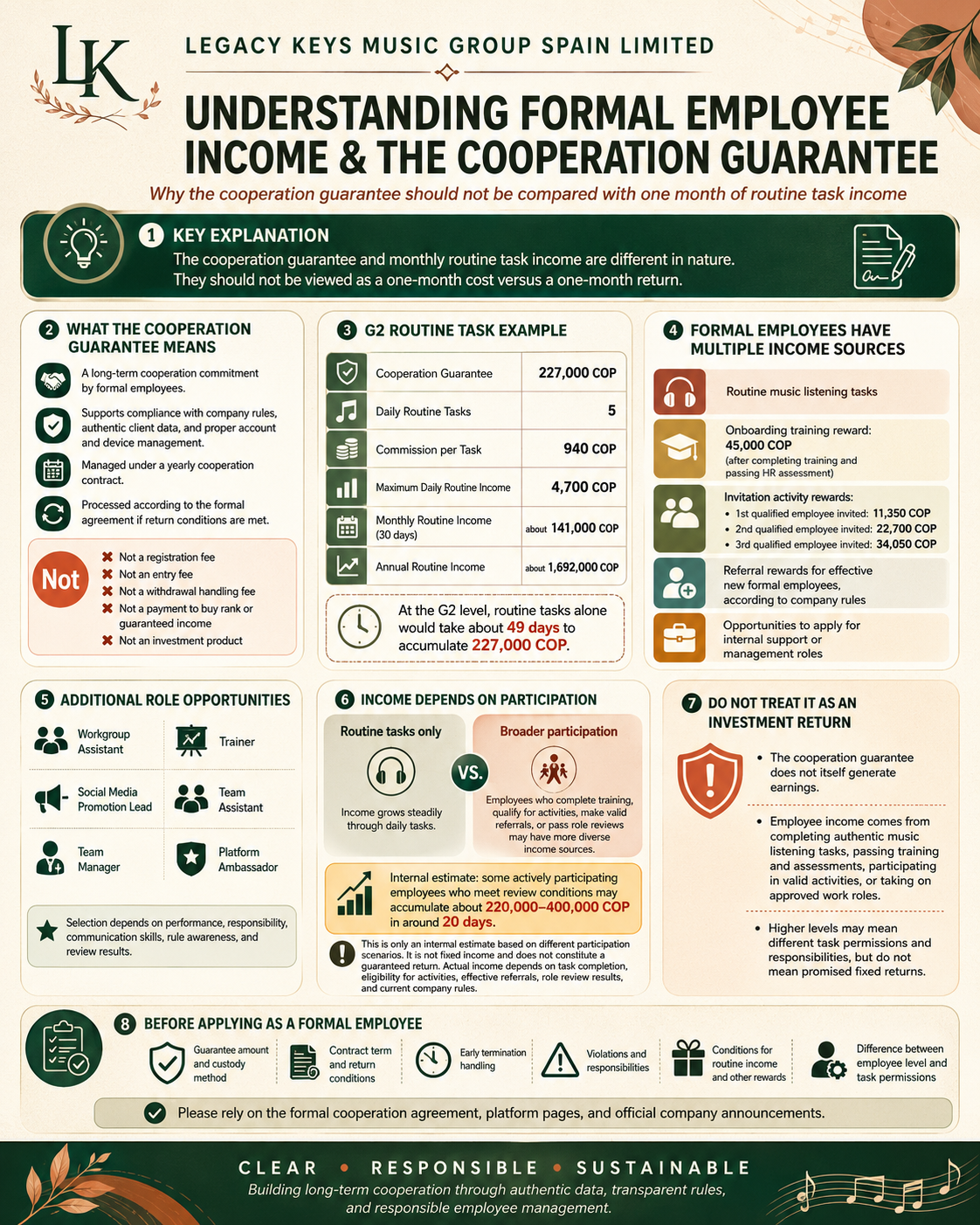
In response, the company states that the cooperation security deposit and an employee’s monthly task income are two items of a fundamentally different nature. They should not be compared simply as a “one-month payment versus one-month return.”
The Cooperation Security Deposit Is Not a One-Month Work Expense
According to the rules provided by Legacy Keys Music Group Spain Limited, the cooperation security deposit represents a long-term employee’s commitment to complying with company policies, protecting the authenticity of client data, and properly managing work accounts and equipment.
The cooperation security deposit is not a registration fee, onboarding fee, withdrawal processing fee, or a payment used to purchase an employee level, a specific number of tasks, or fixed income.
The company states that formal employee cooperation is generally managed under an annual contract. When an employee properly fulfills their cooperation responsibilities during the contract period and meets the refund conditions specified in the agreement, the cooperation security deposit will be handled in accordance with the formal contract.
Therefore, the cooperation security deposit relates to a long-term cooperation arrangement rather than the cost of one month of work.
G2 Regular Task Income Is Approximately COP 141,000 Per Month
Using the Growth 2 employee level as an example, the company’s published information states that a formal employee is required to provide a cooperation security deposit of COP 227,000.
A Growth 2 employee may complete five regular tasks per day, with a commission of COP 940 per task. The maximum daily income from regular tasks is therefore COP 4,700. Based on 30 days, monthly income from regular tasks is approximately COP 141,000, while annual income from regular tasks is approximately COP 1,692,000.
From a single-month perspective, COP 141,000 is indeed lower than the COP 227,000 cooperation security deposit. However, the company states that this comparison overlooks two important factors.
First, the cooperation security deposit relates to a one-year, long-term cooperation commitment rather than a one-month expense. Second, a formal employee’s income is not limited to daily regular tasks.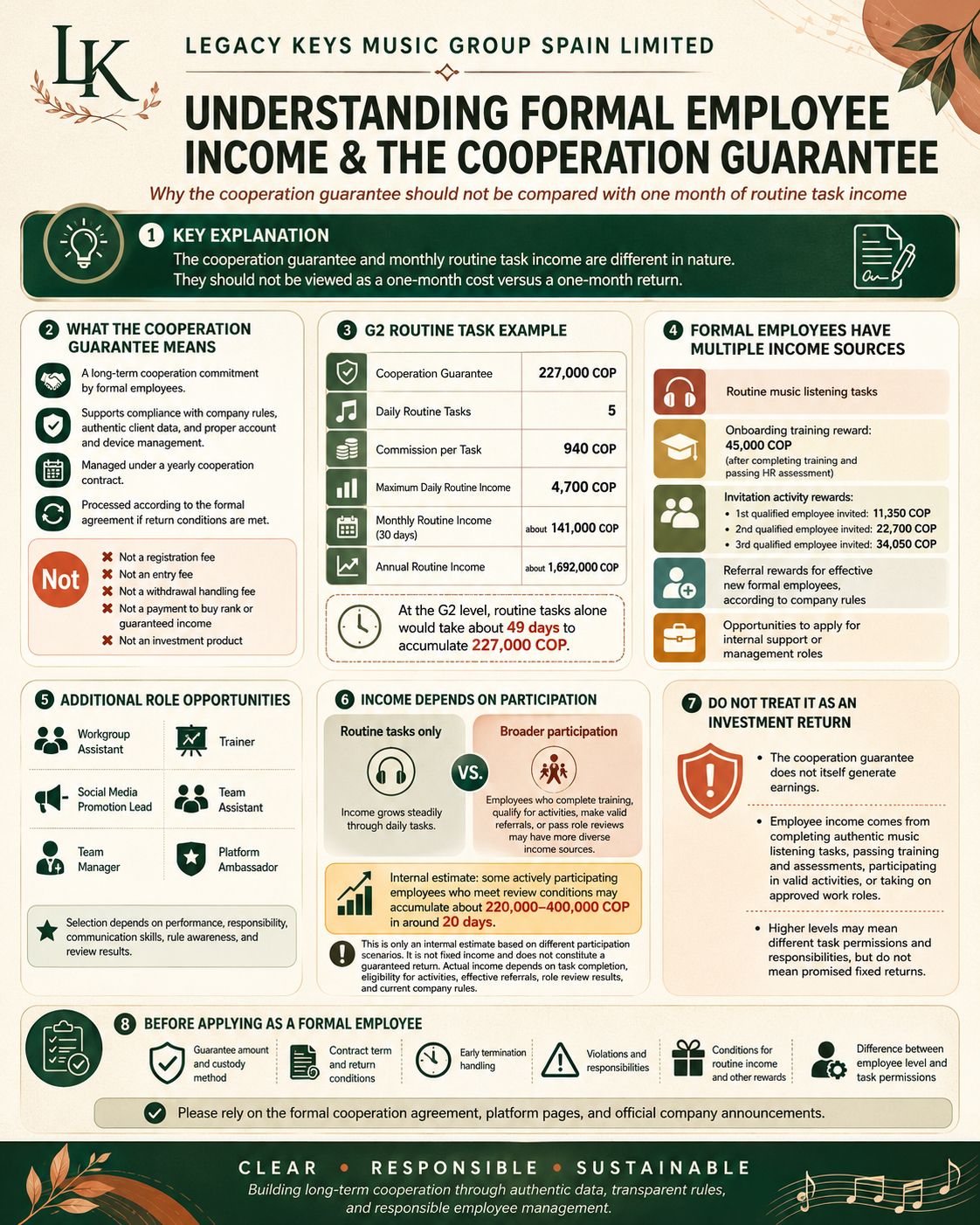
Formal Employees May Have Multiple Sources of Income
Legacy Keys Music Group Spain Limited states that after becoming formal employees, individuals may participate in other formal employee programs in addition to completing daily music listening tasks, depending on their personal performance, eligibility for activities, and review results.
For example, after completing formal employee onboarding training and passing an evaluation conducted by the human resources manager, an employee may receive a training reward of COP 45,000 in accordance with the applicable rules.
The company’s benefits page may also periodically offer invitation campaigns. According to the activity information currently provided by the company:
- Inviting the first qualified employee may earn a reward of COP 11,350;
- Inviting the second qualified employee may earn a reward of COP 22,700;
- Inviting the third qualified employee may earn a reward of COP 34,050.
Formal employees may also receive permission to refer new participants. When an invited person completes training, passes the relevant review, and becomes a valid formal employee, the referring employee may receive a corresponding reward in accordance with company rules.
It should be noted that training rewards, invitation rewards, and referral rewards are all subject to specific conditions and are not automatically granted to every employee.
High-Performing Employees May Apply for Additional Positions
In addition to task income and activity rewards, formal employees who demonstrate strong performance and pass the relevant reviews may apply for internal support or management positions, including:
- Workgroup assistant;
- Trainer;
- Social media promotion coordinator;
- Team assistant;
- Team manager;
- Platform ambassador.
The company states that individuals who meet the position requirements and pass the required training and assessments may receive a fixed salary or management allowance in accordance with the applicable position policies.
Candidates for these roles are generally evaluated based on task quality, communication skills, sense of responsibility, understanding of company rules, and actual work performance. Providing a cooperation security deposit is not, by itself, a direct condition for appointment.
Income Depends on the Individual’s Level of Participation
The company states that employees who complete only daily regular tasks will generally see their income increase at a relatively steady rate. Using Growth 2 as an example, earning COP 227,000 solely through regular daily task income of COP 4,700 would take approximately 49 days.
When employees also complete onboarding training, qualify for activity rewards, make valid employee referrals, or obtain additional work opportunities through position assessments, their overall sources of income may become more diverse.
According to internal estimates provided by the company, some employees who actively participate in different programs and meet the relevant review conditions may accumulate between COP 220,000 and COP 400,000 in approximately 20 days.
However, the company emphasizes that these figures are estimates based on different participation scenarios and do not constitute fixed income or guaranteed returns. Actual income depends on task completion, activity eligibility, the number of valid referrals, position review results, and the company’s applicable rules at the time.
The Security Deposit Should Not Be Viewed as an “Investment Return”
Legacy Keys Music Group Spain Limited states that the cooperation security deposit is not an investment product. It should therefore not be understood in terms of “how long it takes to recover the payment” or whether one month’s income exceeds the deposit amount.
Employee compensation is earned by completing genuine music listening tasks, passing training assessments, participating in valid promotional activities, or performing the responsibilities of a specific position. It is not generated merely because an employee has provided a cooperation security deposit.
The cooperation security deposit itself does not generate interest and does not directly determine an employee’s income. A higher cooperation level may correspond to different task permissions and responsibility requirements, but it does not represent a company commitment to provide a fixed return.
Formal Employees Should Fully Understand the Contract Terms
Before applying to become a formal employee, participants are advised to carefully review the following information:
- The amount of the cooperation security deposit and how it will be held;
- The contract period and refund conditions;
- The procedures applicable to early termination of cooperation;
- Prohibited conduct and the related responsibilities;
- The conditions for receiving task income and other rewards;
- The distinction between employee levels and task permissions.
Employees should rely on the formal cooperation agreement, the information displayed on the platform, and official company announcements. They should not decide whether to participate based solely on verbal promises.
Legacy Keys Music Group Spain Limited states that the central purpose of the cooperation security deposit system is to establish long-term cooperation responsibilities, protect the authenticity of promotional data, and safeguard the shared interests of clients, the company, and employees who comply with the rules.