
From Free Internship to Formal Cooperation: LK Establishes a Phased Employee Participation Mechanism
In digital task platforms, whether new members can understand the work in a low-risk environment is an important factor affecting the stability of long-term cooperation. The phased participation mechanism adopted by Legacy Keys Music Group (LK) in the Colombian market is designed to address this issue.
In digital task platforms, whether new members can understand the work in a low-risk environment is an important factor affecting the stability of long-term cooperation. The phased participation mechanism adopted by Legacy Keys Music Group (LK) in the Colombian market is designed to address this issue.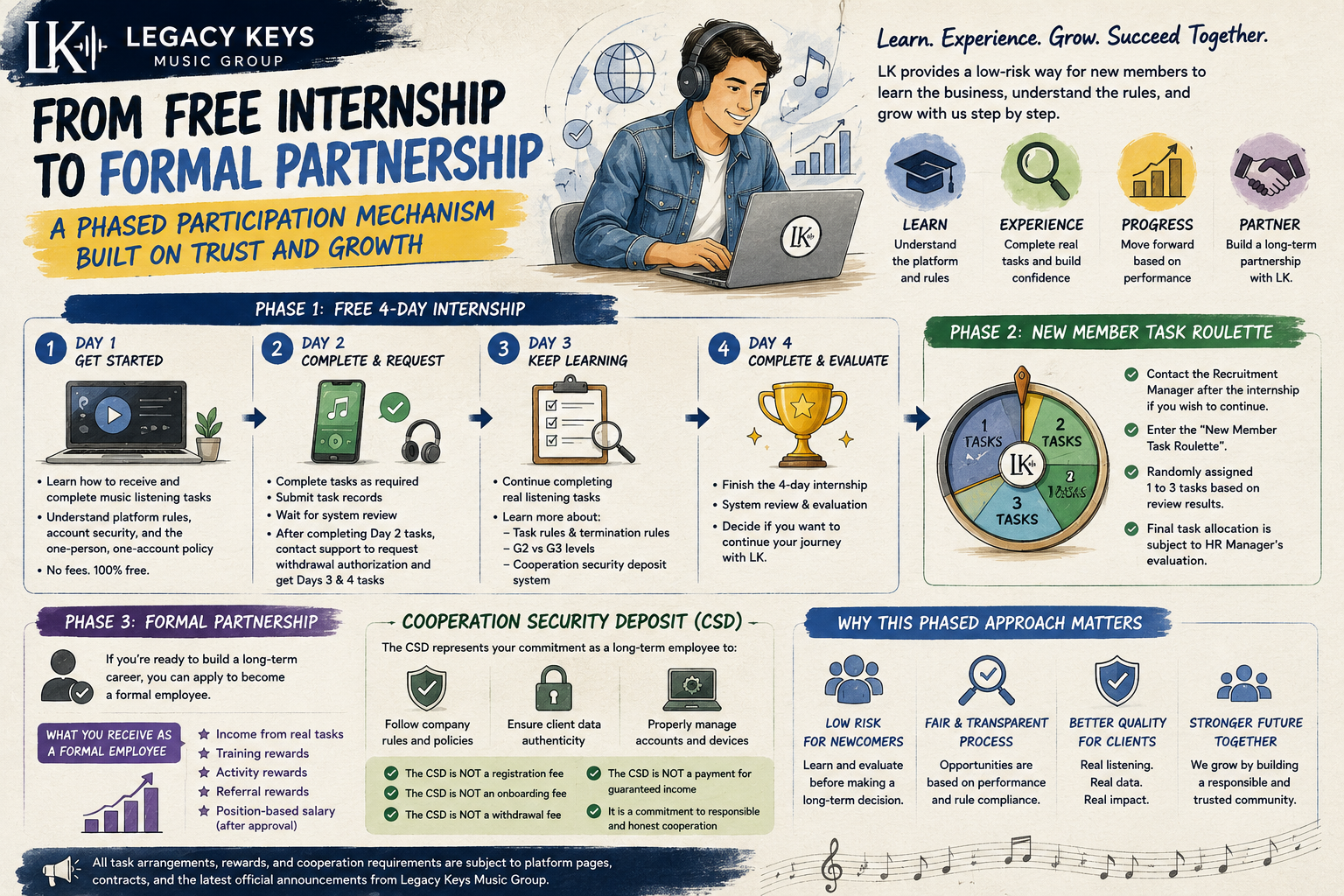
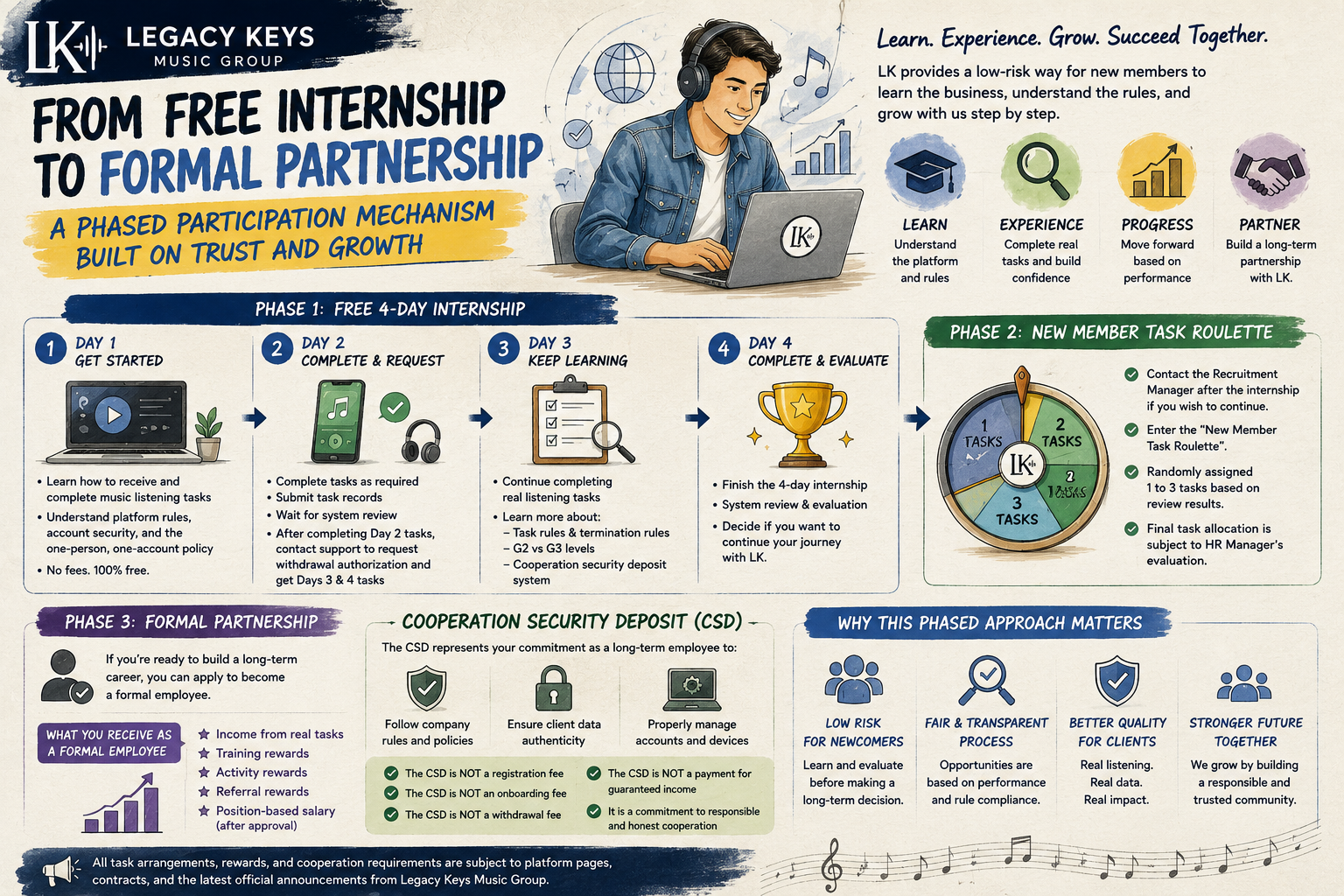
It is understood that new LK members first enter a free internship stage. The internship lasts four days, and participants are not required to pay any registration fee, onboarding fee, or task participation fee. During the internship, participants become familiar with platform operations through music listening tasks while learning the company’s work procedures, account rules, and data authenticity requirements.
This arrangement differs from entering long-term cooperation directly. The internship stage functions more like an observation period for both parties: participants can determine whether the work is suitable for them, while the company can observe whether they demonstrate rule awareness, responsibility, and basic operational ability.
According to LK, after completing the tasks assigned for the second day, interns are required to contact online customer service or the designated team to apply for withdrawal authorization and receive the tasks for the third and fourth days. After completing the four-day internship, those who are satisfied with the work and wish to participate on a long-term basis may contact their recruitment manager to apply for the New Member Task Wheel.
The Task Wheel provides interns with a transitional opportunity before entering formal cooperation. This mechanism may randomly assign one to three tasks, but whether tasks are ultimately assigned still depends on the review conducted by the human resources manager. Through this approach, the company aims to give new members another opportunity to demonstrate their task ability and understanding of the rules.
The formal cooperation stage means that employees enter a longer-term working relationship. Under the rules provided by LK, formal employees are required to provide a cooperation security deposit according to the applicable level. The cooperation security deposit represents a long-term employee’s commitment to complying with company rules and regulations, ensuring the authenticity of client data, and properly managing accounts and equipment.
The company emphasizes that the cooperation security deposit is not a registration fee, onboarding fee, or withdrawal processing fee. It is also not a payment used to purchase fixed income. Formal employee income continues to come from genuine tasks, training rewards, activity rewards, referral rewards, or position-related compensation after passing the relevant review.
Industry observers believe that a phased mechanism can help reduce the likelihood of participants making decisions without understanding the rules, while also helping companies identify individuals who are suitable for long-term cooperation. For the Colombian market, this model provides a clear path from learning and practical experience to formal cooperation.
Specific internship tasks, formal employee applications, and cooperation security deposit rules are subject to the platform page, contract, and the company’s latest announcements.