
Product and advertising are vital for POD success
Product and advertising are vital for POD success
Free daily briefing on global business news.
Print-on-demand success takes more than low startup costs. A reliable partner such as Printful, and paid advertising help POD stores compete.
For many aspiring ecommerce entrepreneurs, print-on-demand products seem like an easy, low-cost way to start selling online, but without advertising and a good printing partner, it is still hard to compete.
Put simply, print-on-demand (POD) is an ecommerce business model where custom products, such as T-shirts or mugs, are printed or manufactured only after a customer places an order. POD removes the two things that used to keep small online sellers out of the physical-goods business, specifically upfront inventory and manufacturing overhead.
What the POD business model does not remove is the much older problem of getting a stranger to find your store and trust it enough to buy. That problem has gotten harder, not easier, in the last two years even as the market opportunity underneath it has kept growing.
The headline numbers are genuinely large, if imprecise. Market-research estimates for the global POD market cluster in the $11 billion to $15 billion range, with most firms forecasting annual growth in the low-to-mid 20% range through the early 2030s.
Specifically, Grand View Research puts the 2026 POD market at roughly $13.1 billion, Mordor Intelligence at $15.2 billion, and Straits Research at $14.6 billion.
The wide spread isn't a red flag so much as a reminder that each firm defines "print-on-demand" and models growth, differently. So, entrepreneurs should treat any single number as directional, not exact.
Finally, North America consistently shows up as the largest regional share, and apparel — T-shirts especially — remains the dominant product category across nearly every estimate.
As promising as those growth estimates might sound, there is a problem.
Search behavior has shifted meaningfully. Independent studies from 2025 and 2026 put the share of Google $GOOGL searches that end without a click anywhere from roughly 58% to 68%, and considerably higher — north of 80% in some measurements — when an AI-generated summary appears directly on the results page.
Estimates of the resulting organic traffic decline vary by study and sector, generally landing in the 15–25% range. The exact figure is genuinely contested, but the direction isn't. A new ecommerce store can no longer count on organic search to send it a meaningful number of first customers the way it could a decade ago. That makes paid acquisition — ads, not blog posts — closer to a fixed cost of entry than an optional growth lever for a new POD brand.
None of that changes the model's appeal. It does mean, however, the two things that actually determine whether a POD store survives are a production partner good enough not to be the bottleneck, and an advertising budget sized for the reality that almost nobody is going to stumble onto a new POD store organically.
Printful is one of the more credible answers to the first half of that equation.
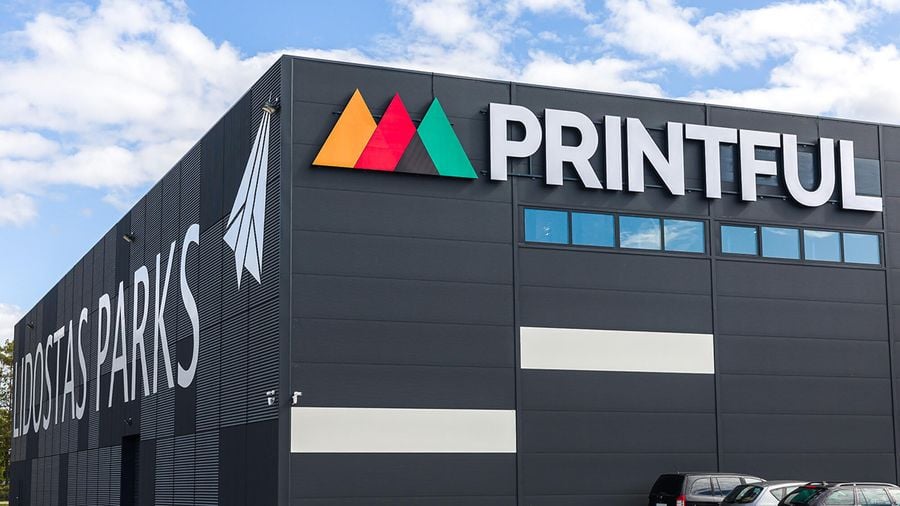
To be clear, there are many good POD manufacturing partners. And one such example is Printful. In fact, Printful has earned this Quartz Editor’s Choice article because it is a leader in POD manufacturing.
To see how the Printful platform actually holds up for a working store rather than a demo account, we worked with a merchant who has created more than 100 science fiction T-shirt designs for a niche Shopify $SHOP storefront fulfilled solely through Printful.
Products for an online t-shirt shop as they appear in the Printful app.
This example store is a reasonable stand-in for the segment Printful is built for, i.e., a single operator running a real catalog, not a print run of one.
Print and product quality. This is Printful's most consistently praised attribute across independent sources and the samples evaluated. Simply put, Printful produces a good quality product.
Printful owns its manufacturing and standardizes its production equipment, rather than routing orders across the patchwork of third-party print shops. That consistency shows up most in things a spec sheet doesn't capture, such as print durability through repeated washes, color accuracy across a print run, and fewer misaligned or defective units.
For a catalog with dozens of distinct designs across multiple garment styles, quality matters more than it would for a single-product store, since quality control has to hold across many different design files rather than just one.
Ease of use and integrations. Setup is genuinely low-friction. Connect Printful to Shopify (or Etsy, WooCommerce, Squarespace, and 20-plus other integrations), upload artwork onto Printful's mockup templates, and a new design is a live listing ready to sell within minutes.
The process works great for small and mid-sized shops. A POD shopkeeper can create many designs at near-zero cost, test various concepts, and find best sellers. As the business scales into dozens and hundreds of product templates, however, the process can become repetitive, and one does what for some kind of bulk update or bulk upload.
Cost structure. No subscription is required to run the store — Printful charges only per order, which keeps the fixed cost of carrying a large catalog at zero even for designs that rarely sell. The optional $24.99/month Growth plan discounts select products by up to 33%, which starts to make sense once monthly order volume is high enough to outweigh the fee—a threshold that, per independent estimates, tends to land somewhere in the range of 15–20-plus orders a month.
Fulfillment. Printful uses in-house U.S. production (Charlotte, NC; Los Angeles, CA) with turnaround of a few business days before an order ships. As expected, fulfillment times can increase during peak selling seasons, so sellers planning around Q4 or other high-volume windows should plan for slower printing and shipping.
Printful's own onboarding material makes a real case for Amazon $AMZN as a channel. A Professional Amazon seller account connects to Printful, designs sync as listings, and Printful handles production and shipping the same way it does for a standalone storefront.
Printful frames the appeal around low setup effort and staying "hands-off" on logistics while still reaching Amazon's existing buyer base — worth noting that framing comes from Printful's own marketing and should be read as an incentive to use the integration, not neutral advice.
The one genuine complication specific to Amazon is barcodes. Amazon normally requires a GTIN (a UPC, EAN, or ISBN) for every new listing, and print-on-demand products — one-off or small-batch, unbranded or private-label — usually don't have one.
Printful's help documentation walks sellers through requesting a GTIN exemption instead. Sellers apply per brand and per category inside Seller Central, submit 2–9 real product photos showing no barcode, and confirm the product genuinely has no GS1-issued barcode.
Amazon typically reviews these requests within 48–72 hours. It's a real extra step — not a dealbreaker, but not the one-click listing experience the rest of the Printful-to-storefront pipeline offers.
As mentioned above, two keys for POD success are the POD platform and advertising. Printful is a good choice for the POD platform, but a new business will still need to invest in advertising.
Shopify's own published guidance on POD profitability is blunt. Most new stores earn very little at first, and marketing is one of the few costs a seller carries entirely on their own — layered on top of whatever the fulfillment platform charges per unit. With organic search sending a shrinking share of traffic anywhere, that marketing line isn't optional anymore; it's the actual cost of entry.
Join 500,000+ readers who start their day with Quartz.
By subscribing, you agree to our Terms of Service and Privacy Policy.
Global business news for a smarter world
© 2026 Quartz Media, Inc. All rights reserved.