
Lawmakers are pushing for AI regulation after an Anthropic researcher's extinction warning
Lawmakers are pushing for AI regulation after an Anthropic researcher's extinction warning
Free daily briefing on global business news.
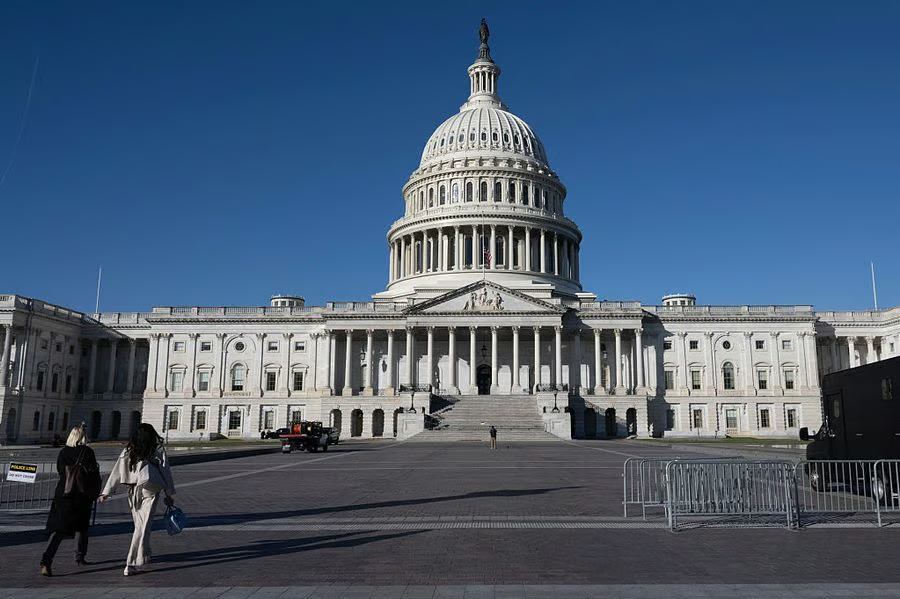
Sen. Ruben Gallego urged Senate leadership to form a bipartisan AI select committee as Rep. Lori Trahan said support has reached "a tipping point"
ANDREW CABALLERO-REYNOLDS/AFP via Getty Images
A push for tougher artificial intelligence rules has drawn support from more than 20 lawmakers this week, prompted by warnings from Jacob Coxon, an Anthropic researcher, that AI labs are "gambling with our lives."
Speaking to CNBC on Friday, Rep. Lori Trahan, D-Mass., declared that cross-party momentum has arrived at "a tipping point." "My phone has rung off the hook this week with rank-and-file Democrats and Republicans who want to see action," she said.
Coxon, who previously worked at OpenAI, announced his resignation from Anthropic on Tuesday in an X $TWTR post that gathered more than 150 million views, according to CNBC. He wrote that the people building AI "earnestly believe that it could kill us all by the end of the decade." Evan Hubinger, Anthropic's alignment science lead, responded by putting his personal estimate of that risk above 10% over the next decade.
Sen. Ruben Gallego, D-Ariz., wrote to Senate leadership on Tuesday calling on Majority Leader John Thune, R-S.D., and Minority Leader Chuck Schumer, D-N.Y., to create a bipartisan Senate Select Committee on Artificial Intelligence when the next Congress convenes. "Jurisdiction over AI is scattered across multiple Senate committees, each with a focused lens but none with the full picture," Gallego wrote. He asked that the committee have subpoena power and be charged with producing actionable legislative recommendations.
Rep. Nathaniel Moran, R-Texas, posted on X that the risks posed by AI are not something Congress can afford to dismiss. "Innovation and safety are not mutually exclusive," he wrote. "We can achieve both through deliberate, thoughtful, and prudent policymaking," according to CNBC.
Several AI bills are already in motion, though none has advanced far. Rep. Trahan and Rep. Jay Obernolte, R-Calif., put forward the FRONTIER Act in July, a bill designed to create governing rules for how advanced AI models are deployed. Also that day, Rep. Moran and Rep. Ted Lieu, D-Calif., put forward the AI Kill Switch Act, legislation that would obligate AI companies to keep functioning mechanisms for halting or suspending their systems. Sen. Bernie Sanders, I-Vt., and Rep. Greg Casar, D-Texas, announced the Ban Artificial Superintelligence Act earlier this month, which would temporarily pause advanced AI development until a federal regulator establishes safety rules.
With both the Senate and House largely on recess ahead of November's midterms, the prospects for any AI bill becoming law in the coming months remain remote. President Donald Trump dismissed extinction concerns on Thursday, telling reporters that "if we don't win AI, we're going to be put in a very bad position."
OpenAI's global affairs chief Chris Lehane published a blog post calling for "mandatory, capability-based national regulation," writing that "the AI policy window is open, for now."
Join 500,000+ readers who start their day with Quartz.
By subscribing, you agree to our Terms of Service and Privacy Policy.
Global business news for a smarter world
© 2026 Quartz Media, Inc. All rights reserved.